09. Continuation toward the expansion of Abderramán II
As you move away from the original core, almost without realizing it, you begin to enter one of the building’s first major expansions, carried out during the reign of Abd-ar-Rahman II in the 9th century, and this step is particularly significant along the tour, because here it becomes evident how the mosque ceases to be a relatively contained initial space and transforms into a constantly growing building—an architecture that expands, adapts, and responds to a changing reality.
This expansion did not arise from an aesthetic consideration, nor from a desire for formal transformation, but rather from a very specific need: the progressive increase in population and the need for a larger prayer space capable of accommodating a greater number of worshippers. Córdoba, at this time, was growing, establishing itself as an increasingly significant political and religious center, and the mosque had to adapt to this new scale.
The solution adopted is particularly interesting because, rather than modifying or replacing what already exists, the decision was made to extend the building southward, widening the naves while largely maintaining the same construction system. This approach, which may seem simple, is in fact a key decision, as it defines how the building will evolve in subsequent phases.
If you stop to look closely, you’ll notice that the transition between the original area and this extension is quite seamless. There’s no obvious break, no abrupt change marking the shift from one phase to another, which reinforces that sense of continuity you’ve been feeling since you entered the interior. The space seems to extend naturally, as if it had always been that way.
However, that continuity does not imply exact repetition. If you pay attention to the details, you will begin to notice small variations, subtle adjustments, differences in materials, in proportions, and in the way certain elements are executed. These are discreet changes that do not alter the overall impression but reflect the building’s evolution and its adaptation to new circumstances.
This type of growth is one of the mosque’s most fascinating characteristics. It does not follow a fixed design from the outset; it is not a building conceived all at once, but rather the result of an open-ended process in which each intervention integrates with what already exists, expanding it without destroying it. It is architecture that grows organically, that develops over time, that incorporates new needs without losing its identity.
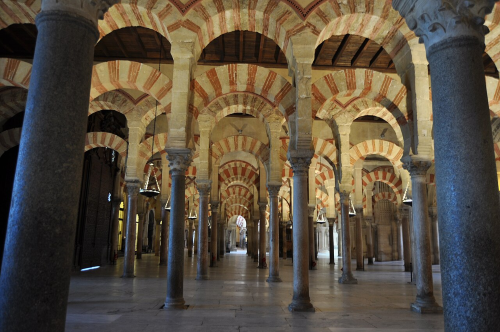
As you move deeper into this area, the sense of space begins to expand. The repetition of columns and arches extends, multiplies, and intensifies, reinforcing the effect of continuity. What in the original core might have been perceived as a more contained space begins here to take on a greater dimension, greater depth, and greater expanse.
This change is not abrupt; it is gradual, almost imperceptible at first, but very significant when observed closely. It is as if the space were breathing, as if it were expanding little by little, accompanying the growth of the building and the community it served.
It is interesting to note how, despite this expansion, the structural logic you saw earlier is maintained. The same solutions, the same rhythms, the same relationship between columns and arches—all of this contributes to the complex functioning as a single unit. This coherence is fundamental, because it prevents the building from being perceived as a sum of independent parts, and instead creates a continuous, fluid experience without clear interruptions.
At the same time, if you look more closely, you can identify those subtle differences that mark the passage of time. Small variations in the capitals, in the materials, in the execution of the arches—details that, though discreet, allow you to read the building’s history directly through its architecture. You don’t need major changes to perceive the evolution; it’s enough to pay attention to these nuances.
The space you’re now walking through is no longer the original one; it’s a space that has grown, designed for a broader community, for a city that has changed, gained importance, and needs a building suited to that new reality. This expansion thus represents a first step toward the monumentality the mosque will achieve in later stages.
As you continue walking, you can notice how the repetition intensifies, how the rhythm of the space becomes more constant, more enveloping. Far from being monotonous, this repetition generates a sense of stability, order, and continuity that defines the experience of the place.
At the same time, if you keep a close eye out, you will begin to perceive how the space transforms little by little, how that continuity incorporates small differences that enrich your perception. This combination of repetition and variation, of continuity and change, is one of the keys to the architecture you are exploring.
This point marks the beginning of a series of expansions that will continue in the following stages, leading the building to achieve a much larger scale, increasing complexity, and a richness that will unfold as you proceed.
Continue moving in the same direction, leaving the original core behind and entering these first phases of expansion, because in the next area you will begin to perceive how the architecture continues to evolve, incorporating new solutions and taking on an even more complex dimension.
Comentarios
Aún no hay comentarios.