11. Caliphal domes
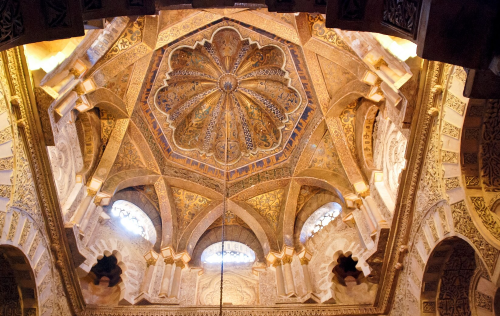
When you look up in this area, the experience of the tour changes instantly, because one of the most extraordinary ensembles in all of Caliphate architecture appears before you: the so-called Caliphate domes, located in the antechamber of the mihrab. Up to this point, the building’s power has relied primarily on horizontal repetition—on the continuity of columns and arches—and on that sense of expansion that seems never-ending. Here, however, the architecture begins to focus upward, drawing the eye upward, transforming the roof into a visual and symbolic focal point of the highest order.
These domes should not be understood as mere solutions for covering a space, nor as an ornament added to an existing structure. They are, in themselves, an architectural statement. Their technical complexity, their geometric refinement, and their position along the route indicate that we are at a particularly significant point. The architecture no longer merely accompanies; now it seeks to impress, to distinguish, to emphasize that the visitor has reached an area of the highest artistic quality and immense significance within the mosque.
If you look closely, you will see that these domes are formed by ribs that intersect in a complex manner, creating a highly elaborate geometric pattern. They are not solid domes, nor are they visually heavy, but rather structures that combine solidity and lightness in an extraordinary way. The ribs organize the upper space and generate a sense of dynamism, of controlled tension, of mathematical perfection. The gaze does not remain still; it moves from one line to another, following the intersections, the curves, the junctions, and discovering how geometry can become a form of beauty.
One of the most fascinating characteristics of these domes is precisely that ability to appear light, almost suspended, despite their structural complexity. They do not convey a sense of weight, but rather of elevation. Instead of overwhelming the space, they ennoble it, making it more vibrant, more sophisticated, more ceremonial. This apparent lightness is no accident; it is part of a highly refined architectural concept, in which technique serves not only stability but also the aesthetic and spiritual experience.
The placement of these domes is essential. They do not appear just anywhere in the mosque, but right before the mihrab—that is, in a section of the building where the architecture begins to intensify and signal the importance of the place the visitor is approaching. They function, in a way, as an elevated antechamber, as a visual and symbolic preparation. You are no longer simply walking through a vast, repetitive prayer hall; you are now entering a space where the architectural quality reaches an exceptional level and where every element seems to indicate that you are approaching a center of special significance.
Light plays a decisive role here. Unlike other areas of the building, where the lighting feels more uniform and filtered, in this area the light interacts with the forms in a more intense way. The ribs, surfaces, curves, and openings create a play of light and shadow that enhances the visual richness. The domes are not merely a structure to be admired; they are a space experienced through the gaze, a place where perception shifts depending on the angle, the position, and the time you spend observing.
It is important to pause for a few seconds and look up calmly. On a quick visit, there is a risk of getting carried away by the flow of the tour and not giving the roof enough attention, but here it is well worth doing so. These domes are one of the great achievements of the architecture of the Caliphate of Córdoba, a testament to the exceptionally high technical and artistic level attained during this period. They combine construction expertise, aesthetic sensibility, and a profound understanding of geometry as a tool for creating order, beauty, and symbolism.
This type of solution does not appear in isolation, but within a highly sophisticated architectural culture, where geometry is understood not merely as a technical resource, but as a way of expressing harmony, perfection, and transcendence. In this sense, the domes do not merely cover; they also signify. They are an elevation of the building’s language, a concentration of constructive intelligence and artistic ambition.
Architecture, at this point, is no longer limited to repeating a successful system, but takes it to a higher level. Everything you have seen before—columns, arches, rhythm, continuity—finds here a sort of partial culmination, a moment in which the building demonstrates how far it can go within its own language. The Caliphate domes are innovative, beautiful, complex, and deeply coherent with the whole, yet at the same time they introduce a new intensity, a distinct accent within the journey.
Here, too, the relationship between power and architecture becomes more evident. These solutions reflect not only technical capability but also a desire for magnificence. In the context of the Caliphate, erecting such a space implied demonstrating mastery of construction, cultural refinement, and an enormous capacity for representation. The mosque was a religious building, yes, but also an emblem of Córdoba’s prestige, and these domes form part of that image of excellence.
On an emotional level, the effect on the visitor is very clear. After passing through expansive areas where continuity dominates the experience, this point captures one’s attention and evokes a kind of vertical awe. The gaze, which until now had moved primarily horizontally, rises, pauses, and is taken aback. The space gains symbolic depth and visual intensity. Everything seems to indicate that you have entered a particularly significant part of the building.
That sensation is no accident. The domes are part of a carefully composed sequence, in which the architecture prepares the way toward the mosque’s most important space. They are an antechamber, yes, but an extraordinary one—one of those spaces that not only lead to another but possess value in and of themselves. They are, at once, a passageway and a visual destination.
Before continuing on, take a moment to observe how the ribs intersect, how they interact with the lower arches, how the light shapes the surface, and how the space seems to become richer, more intense, more precise. That shift in intensity is one of the keys to this section of the tour.
Continue now at a leisurely pace, because just ahead you will enter a space that was not intended for everyone, but reserved for a very specific function within the political and religious life of the Caliphate—an area where the architecture also expresses hierarchy, protection, and power.
Comentarios
Aún no hay comentarios.