01. Gate of Forgiveness
Welcome to the Mosque-Cathedral of Córdoba, a truly unique place where different cultures, religions, and historical periods intertwine within a single space, and which has been designated a UNESCO World Heritage Site.
Throughout this tour, you will discover how this building, which began as a mosque in the 8th century, has been transformed over time into the cathedral you see today, while retaining the essence of its various stages and integrating centuries of history, change, and evolution into its architecture—making it one of the most extraordinary examples of continuity within European heritage.
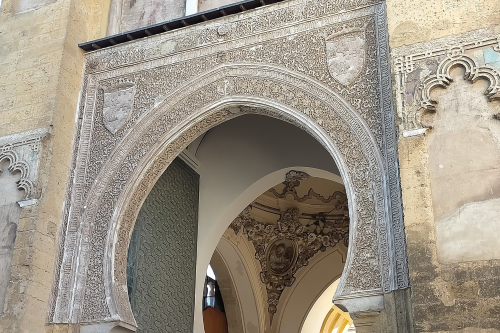
You are now standing before the Puerta del Perdón, one of the main entrances to the complex, and also one of the best places to begin to understand not only the building itself, but the logic by which it has been conceived, used, and transformed over the centuries. This place is not merely a physical entrance; it is not just a passage from one space to another. It is also a symbolic threshold, a point of transition between the city of Córdoba and a space that, from its very origins, has been deeply linked to religion, community life, and the representation of power.
The very name of this gate, Puerta del Perdón, already places us in a specific stage of its history—the Christian era—when the former Islamic building became integrated into the cathedral tradition. In this context, the entrance takes on a different meaning, associated with the idea of redemption, of passage into a sacred space, thereby reinforcing the symbolic dimension of the journey. However, beneath this name and its current form, the imprint of its Islamic origins remains, making this site a clear example of historical layering, where different layers of meaning coexist in the same place.
If you look closely, you will see that the gate before you does not belong to a single era nor adhere to a single style. Its current appearance is the result of multiple interventions over time, especially during the Christian period, although it still retains elements that evoke its Al-Andalus past. This combination of styles, materials, and construction techniques is not an exception but a constant throughout the complex, where each historical period has left its mark without completely erasing what came before.
The origins of this site date back to the year 785, when Abd-ar-Rahman I ordered the construction of the first mosque on this very site. This decision was no accident, as it was a strategic point within the city, a space that had already held significant meaning in earlier periods. From that moment on, the building began a process of continuous growth, driven by various rulers, who would expand the mosque to adapt it to the needs of an expanding city and to Córdoba’s growing importance within the Western Islamic world.
During this period, the mosque was not merely a place of worship; it was also a center of power, knowledge, and social life. Its size, complexity, and architectural richness reflected this multifaceted role, making it one of the great landmarks of Islam in the West. Centuries later, with the Christian conquest of the city in 1236, the building changed its function, but it did not disappear—it was transformed. This fact is essential to understanding what you are about to see, since, unlike other places where previous structures are completely replaced, here the choice was made to integrate, adapt, and reuse what already existed.
This process of transformation was neither immediate nor uniform, but rather gradual, resulting in a building where very different architectural solutions coexist. The former mosque became a cathedral, yet it retains much of its original structure, creating a unique coexistence between two religious and cultural traditions. This coexistence is not merely a superimposition; it is a constant dialogue between the different parts of the building—an architectural conversation that can be perceived throughout the entire tour.
From this point, moreover, you can begin to sense the general layout of the complex. Although you have not yet entered the interior, the arrangement of the walls, the scale of the structures, and the presence of various entrances around you allow you to perceive that you are facing a complex space, organized into different areas. There is no single entrance or single route, but rather a network of entrances that serve different functions and correspond to different historical periods, reinforcing the idea that this building has always been in use, continually adapting to circumstances.
The relationship between the building and the city is also highly significant. The Puerta del Perdón acts as a filter, separating the urban space from the religious precinct, yet simultaneously connecting them. Over the centuries, this entrance has been used by all kinds of people, from the faithful to authorities, giving it a significant role in the daily life of Córdoba. It is not merely an architectural element; it is also a meeting point, a passageway, a transition between the everyday and the symbolic.
If you pause for a moment, you will notice how the scale of the gate and the walls surrounding it is designed to create a sense of monumentality. It is not merely about granting access, but about marking an experience, signaling that you are entering a place of special significance. This type of design is common in religious architecture, where the entrance is an essential part of the journey and the perception of the space.
The materials, proportions, and integration of the gate within the complex all serve this purpose. Despite the modifications it has undergone over time, it retains that ability to impress, to create a pause before entering. That moment of transition is important because it prepares the visitor for what they are about to experience, not only physically but also emotionally.
Another interesting aspect is the continuity of use reflected by this site. For centuries, very different people have passed through this door with equally diverse intentions, ranging from Islamic prayer to Christian celebrations, as well as everyday activities tied to city life. This accumulation of experiences is part of the value of the place, which is not merely a building but a lived space.
Before continuing, it is worth pausing for a few seconds to calmly observe your surroundings. Notice the details, how the ancient and more recent elements combine, and how each part integrates into the whole. This exercise will help you recognize, throughout the tour, the layering of periods that defines the entire monument.
You are about to cross a threshold that will not only take you to another physical space but will also introduce you to a sequence of places designed to be explored progressively. Little by little, you will leave the exterior behind and enter an increasingly complex space, where history, architecture, and perception intertwine in a unique way.
Now, pass through the Puerta del Perdón and continue into the interior of the complex.
Comentarios
Aún no hay comentarios.