07. Bicolored arches
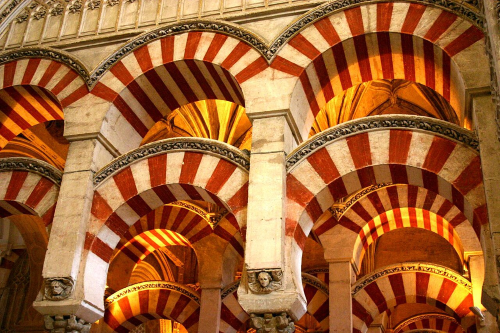
If you look up, you’ll discover one of the most iconic features of this space: the two-tone arches that repeat over and over, forming an unmistakable visual pattern that defines the identity of the interior of the Mosque-Cathedral of Córdoba. The alternation between light stone and reddish brick creates a rhythmic sequence, almost like a visual cadence, that accompanies your journey and generates an enveloping, continuous sensation rarely found in other buildings.
However, beyond their beauty and aesthetic power, these arches serve a very specific structural purpose. As you may have noticed with the columns, the reuse of materials meant working with pieces of varying heights, sourced from different contexts, which made perfect alignment impossible. It was therefore necessary to find a solution that would unify the whole without sacrificing the available elements. And it is precisely here that one of the great triumphs of this architecture emerges.
The answer to this challenge was the creation of a system of overlapping arches, an ingenious solution that not only resolves the technical problem but also creates one of the building’s most distinctive visual features. The first level of arches rests directly on the columns, establishing a firm and stable foundation, and rising above it is a second level that adds height, evens out the structure, and distributes the weight more effectively.
This system not only serves a structural function but also defines the visual character of the space. The repetition of these arches, their superimposition, and their constant rhythm generate a sense of order that contrasts with the diversity of the columns, creating a very particular balance between variety and coherence.
The alternating use of stone and brick is also no accident. Each material has distinct properties, and their combination allows for more efficient construction. But beyond that, this alternation creates a very powerful visual effect, making the arches one of the building’s most recognizable features. The red and white bands not only structure the space but also energize it, guiding the eye and reinforcing the sense of continuity.
This technique has precedents in other architectural traditions, but here it reaches an exceptional level of development, both in terms of scale and the way it is systematically applied throughout the entire complex. It is not a one-off element, but a system that repeats itself, extends, and defines the space in its entirety.
As you walk through this interior, you can observe how the arches align, visually intersect, and overlap in the distance, creating optical effects that constantly change depending on your position. This interplay of perspectives makes the space not static but dynamic, transforming with movement and always offering new views.
It is interesting to pause for a moment and look in different directions—forward, to the sides, even backward—to see how this visual coherence is maintained throughout the entire space. No matter where you look from, the system remains, the rhythm repeats, the structure is recognizable. This kind of overall perception is essential to understanding the building’s logic, which is not based on isolated elements, but on the repetition of a single system.
At the same time, if you pay close attention, you will begin to notice small variations—subtle differences that reflect the different phases of construction. Not all arches are exactly the same; not all sections correspond to the same historical period. These differences, though subtle, allow us to trace the building’s evolution, to understand how it has grown and adapted over time.
The relationship between the arches and the columns is also key to understanding how the space functions. The arches are not merely a decorative element; they are the component that enables the entire system to function, connecting the different parts, distributing the loads, and giving coherence to the whole.
Furthermore, this system of overlapping arches helps reinforce one of the mosque’s most characteristic sensations: that of a space extending without clear boundaries. The constant repetition, the lack of a dominant focal point, the visual continuity—all of this generates a perception of infinity that is an essential part of the experience.
As you move through this space, you can feel how your gaze adapts to that rhythm, how it is carried along by the repetition, how it finds a kind of balance in that continuity. It is an experience not based on a single moment of surprise, but on accumulation, on reiteration, on constancy.
It is also interesting to observe how light interacts with the arches, how it filters through them, how it softens their contours, how it contributes to creating that homogeneous atmosphere that characterizes the interior. The light does not highlight one arch over another, but rather integrates them into a continuous whole.
This balance between structure and perception is one of the building’s key features. The arches solve a technical problem, but at the same time they generate a unique aesthetic experience—a way of perceiving the space that does not depend on a single element, but on the repetition of many.
As you continue to move through this space, your gaze will grow accustomed to this system; it will begin to recognize its patterns, its rhythms, its variations. And it is precisely this familiarity that will allow you to perceive more clearly the changes that will appear further on.
Pay attention to the details, to the small differences, to the way the arches relate to one another, because in the next area you will begin to enter the original core of the building, the point where the history of this space as we know it today begins.
Comentarios
Aún no hay comentarios.