19. High altar and choir
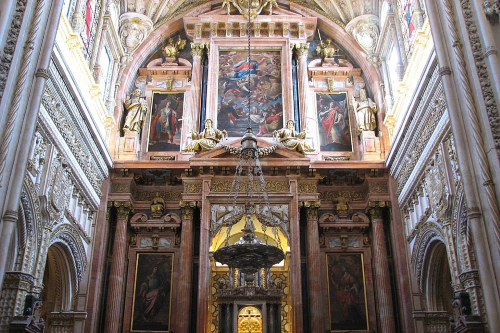
In this part of the route, the way you experience the space changes once again in a very clear way, because you leave behind the continuous logic of the former mosque and fully enter the central area of the cathedral—a space where everything begins to be organized differently: more directed, more hierarchical, more focused on an axis and a main point. That point is the high altar, the core of Christian worship within the building, and the element around which this new way of understanding and experiencing the space is structured.
The high altar is not only an architectural feature or a visually prominent element; above all, it is the place where the central ritual of Christian worship takes place, where the mass is celebrated, where the religious meaning of this part of the building is concentrated. Its position, its scale, and the way it is framed by the surrounding architecture are all designed to make it visible, to highlight it, and to turn it into the point toward which the gaze is directed.
If you observe carefully, you will notice how the architecture here stops functioning as an open, repetitive, and homogeneous space and instead becomes more clearly organized around a center. The lines of the whole, the arrangement of volumes, the relationship between the different elements—all lead toward that main point. The logic changes very clearly. In contrast to the continuous horizontality that defined the experience of the mosque, a marked visual hierarchy appears here, a structure in which each part occupies its place within a defined order.
The decoration surrounding the altar further reinforces this change. In contrast to the abstraction, geometry, and repetition that characterized much of the Islamic space, here you find figurative elements, scenes, symbols, and details that do not simply decorate, but also communicate, represent, and narrate. It is a different way of conceiving art within a religious space—one that gives prominence to imagery and visual storytelling, seeking to direct attention and convey meaning more directly.
Next to the altar, the choir also occupies a fundamental place within the whole. This space, intended for the clergy, is one of the most characteristic elements of cathedrals, and its presence here reinforces the new organization of the building. The choir stalls, intricately carved, are not only functional elements but works of art in their own right, the result of a tradition that places great importance on liturgy, solemnity, and representation within the sacred space.
It is worth pausing for a moment, because the choir also introduces a dimension that is not always visible during a quiet visit: the acoustic dimension. This space was designed to host voice, chant, and liturgical music, and its entire configuration responds to that function. Although this may not always be fully perceived today, the architecture is prepared to support and amplify that experience, enveloping it and integrating it into the space. Here, not only what is seen changes, but also how this place could be heard.
It is interesting to observe how the choir relates to the rest of the building. It does not appear as an isolated element, but as an integrated part of the overall organization of the cathedral. It has its own presence, its own scale, its own structure, yet at the same time it forms part of a larger system in which each element responds to a precise logic.
On a spatial level, this point marks a very clear difference from what came before. The height, the light, the way the elements are arranged, and even the way the space is experienced—all contribute to creating a different sensation: more directed, more organized, more focused on the experience of Christian worship. The gaze no longer moves freely in a horizontal way, as it did among the aisles of the mosque, but instead tends to concentrate on specific points.
Light plays a particularly important role here. Unlike the more diffuse and uniform lighting of the Islamic space, in this area it can be more concentrated, highlighting specific elements and creating stronger contrasts, thus reinforcing the visual hierarchy of the whole. The altar, the choir, and the main areas of the cathedral space gain a more intense presence thanks to this different use of light.
The relationship between the visitor and the space also changes. In the mosque, moving through the interior meant being part of a continuous environment, almost without visible hierarchies, where perception depended on movement and repetition. Here, by contrast, the architecture establishes a direction, a distance, a more defined way of positioning oneself. The gaze no longer disperses; it concentrates. The route is no longer entirely free, but more guided.
This change, however, does not imply a complete replacement of one architecture by another. What makes this place particularly unique is that the cathedral space does not exist in isolation, but is inserted within the structure of the former mosque. It coexists with it, relies on it, develops within it. If you look to the sides, you can still see the columns, the arches, the rhythm of the original building, and this coexistence of both architectural languages is one of the most fascinating aspects of the monument.
In this sense, the high altar and the choir represent the core of the building in its Christian phase, just as the mihrab did in its Islamic phase. They are two different centers, two ways of organizing space, two ways of understanding religious architecture, which do not completely replace one another, but coexist within the same whole.
Before continuing, take a few seconds to pause and observe this space calmly—perceive its differences, understand how it is organized, how it is articulated, and how it relates to everything you have seen so far. This moment is essential for understanding the transformation of the building, not as a total break, but as a complex superposition full of nuances.
From here on, the route will lead toward the lateral areas, where the architecture will change once again, where the space becomes more fragmented and diverse, and where new interventions will appear, reflecting the long evolution of the monument over time.
Comentarios
Aún no hay comentarios.