15. Almanzor’s expansion
You are now entering one of the final major phases of expansion of the former mosque, the one promoted by Almanzor at the end of the 10th century. This moment is essential to understand how the monument reached truly extraordinary dimensions. This is not a radical transformation of architectural language, nor a search for new formal effects, but rather a systematic extension of an already established model—an expansion that clearly embraces continuity, repetition, and the efficiency of a system that had already proven its effectiveness.
In this area, the architecture does not aim to surprise through abrupt changes, nor to draw attention to a singular element, as was the case in the earlier caliphal section. Instead, it focuses on expanding, multiplying, and extending the space in an orderly, almost methodical way. The building grows eastward, adding new parallel aisles that maintain the same rhythm of columns and arches, creating an expansion that reinforces the identity of the whole without significantly altering it.
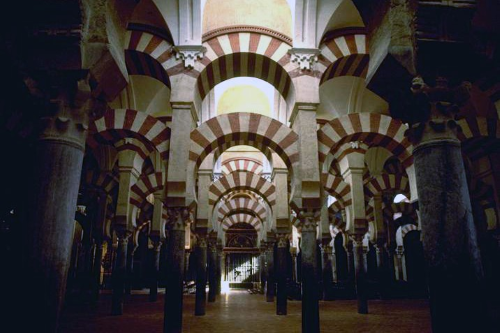
If you pause for a moment and observe carefully, you will notice that the structure is entirely recognizable. The alignments continue, the repetition of supports remains, as does the system of superimposed arches and the horizontal organization of space. Everything follows the same logic you have seen so far. However, the perception changes, because here repetition becomes more intense, more dominant, more constant—almost absolute. The architecture ceases to offer meaningful variation and becomes a continuous sequence in which each section follows the previous one without introducing major differences.
This type of growth responds to a very specific need. At the time of this expansion, Córdoba was already a city of great importance, with a large population and intense religious activity. The mosque had to adapt to this reality, and the most effective solution was not to reinvent the space, but to expand it following the existing model, taking advantage of its capacity to organize large surfaces coherently.
One of the most interesting aspects of this expansion is how it reinforces one of the building’s most distinctive features: the sense of almost unlimited continuity. As you move through this area, your gaze travels without encountering a clear endpoint. The columns follow one another, the arches repeat, and the space extends, creating a perception of vastness that goes beyond its physical dimensions.
This effect is not accidental; it is a direct consequence of the systematic repetition of the same structural scheme. There are no interruptions, no abrupt changes, no elements that break the rhythm. Everything remains constant, and precisely for that reason, the sense of extension intensifies. The space seems endless, as if it continues beyond what is visible, creating a very particular experience.
At the same time, you will notice that the decoration in this area is more restrained than in other parts of the building. You will not find here the ornamental richness of Alhaken II’s expansion, nor the symbolic concentration that characterizes the area around the mihrab. This space is more sober, more uniform, more focused on repetition than on singularity—and this difference is key to understanding the experience.
The absence of elements that concentrate attention allows the eye to move more freely, without stopping at specific points. The architecture no longer directs or points things out, but instead offers a more open space in perceptual terms, one that can be experienced in a more personal way.
Repetition, far from being monotonous, becomes the true language of the space. Every column, every arch, every section forms part of a larger system that expands and consolidates itself. It is an architecture that asserts itself not through difference, but through persistence, accumulation, and continuity.
This repetitive character also has an interesting perceptual dimension. As you move, you may notice how the space seems to change without actually changing—how perspectives shift and elements align differently depending on your point of view. It is a constant, subtle visual play that keeps the experience alive without the need for major formal variation.
It is also worth considering that this area reflects a different stage of Andalusian power. While the expansion of Alhaken II shows a clear intention of refinement, representation, and artistic sophistication, here the emphasis is on capacity, scale, and functionality. The architecture responds to different needs, resulting in a space that is less ornamental but equally impressive for its scale and coherence.
As you walk through this area, try changing your line of sight—look to the sides, behind you, or diagonally—and observe how the space maintains its logic in every direction. There is no privileged point from which to fully understand it, no single correct perspective, but rather a multiplicity of viewpoints that reinforce the idea of continuity.
This quality is especially important because it breaks with the idea of a linear route. The building is not conceived as an axis to be followed from beginning to end, but as an extension that can be experienced from different positions and perspectives.
This part of the visit is key to understanding the overall dimension of the building—its ability to grow without losing its identity, and its way of constructing space through repetition. Here, the architecture reaches one of its limits in terms of extension, demonstrating how this system could adapt to new needs without requiring a radical transformation.
And it is precisely this repetition, this almost uninterrupted continuity, that in the next section will give rise to one of the most characteristic sensations of the visit: the perception of a space that seems to have no end, extending beyond what is visible and transforming the very way we understand architecture.
Comentarios
Aún no hay comentarios.